
SWING OF FEAR
We are taught to hide our emotions; that is the starting point. The issue feels even more familiar in a world where ghosting has become a socially acceptable way to deal with a breakup.
Instead, we should look at them as we look at ordinary objects.
Pride is a black stone.
Sadness is a puddle.
Joy is the sky.
Fear is an empty box.
For me, the first description of fear came from The Haunting of Hill House by Shirley Jackson. Unlike the classic ghost stories we are accustomed to, the novel’s greatest strength lies in never showing anything supernatural. Throughout the novel, you wait for the worst to happen, yet it never does. Shirley was trying to look at the face of anxiety, fear’s first daughter. When Shirley Jackson first published The Lottery in The New Yorker, she personally received hate mail, and many subscriptions were cancelled.
Of all emotions, fear is probably the one we give the least space to. It is constantly pushed to the margins of everyday life, experienced alone and in silence. As adults, it is not socially acceptable to just say “I am afraid”. You must add something. Afraid of what? What is the object? If there is an object, we can act on it. If there is no object, the fear just stands there. What’s the purpose? Again, like many other emotions, fear ends up being shut down as uncomfortable, annoying, and even awkward.
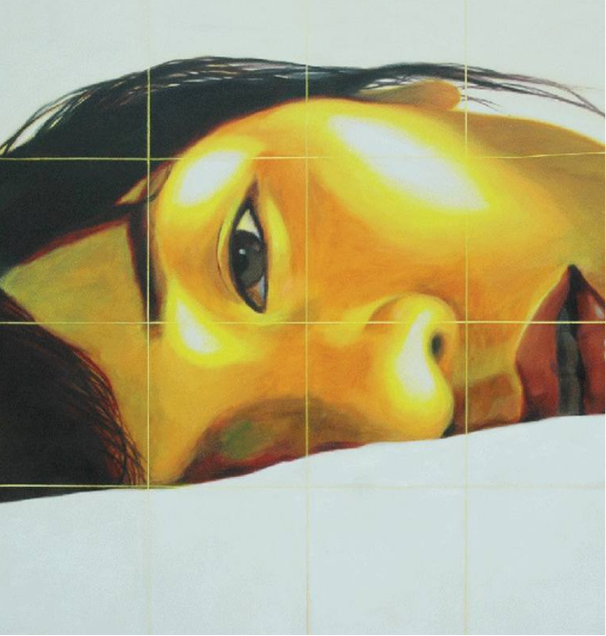
"Long tears of broad lake" - Hyun Kim
This is why fear feels so isolating.
Not because everyone experiences it differently, but because everyone experiences it in private. We rarely announce it or share it. Instead, we learn to translate it and reshape it into more acceptable languages, such as stress or irony.
Fear remains underneath, unnamed.
That is what makes The Haunting of Hill House so unsettling. The novel never asks us to fear a monster; it asks us to confront something much closer and more common: the feeling of being trapped in an emotion with nowhere to go, the fear of not belonging, of not being understood, of occupying a space without ever feeling at home in it.
In this sense, fear starts to become isolation more than emotion; it is the experience of carrying something that cannot find a voice, which is pushed to the margins.
If we accept that fear is what happens when something remains trapped inside us, then perhaps art begins when that silence becomes unbearable.
What happens when something repeatedly pushed to the margins finally finds a way to speak?

Fearless, Pink Floyd
Jazz offers one possible answer.
While reading Ted Gioia’s The History of Jazz, I found myself thinking less about music and more about the people behind it.
The early chapters describe communities in New Orleans striving to preserve fragments of a culture that had been violently displaced.
African musical memory survived.
Rhythms survived.
Chants survived.
Certain ways of gathering and making music survived.
What could not survive politically survived musically, mainly through improvisation and capacity to reshape the sounds.
What is striking is not the historical fact itself, but the determination behind it. These communities were moving between parallel lines, representing two parallel realities: real-life struggles, with the need to improvise in a radically different environment; and musical orientation, and the need to adapt that struggle to the musical traditions they carried with them, finding a way to leave traces of themselves.
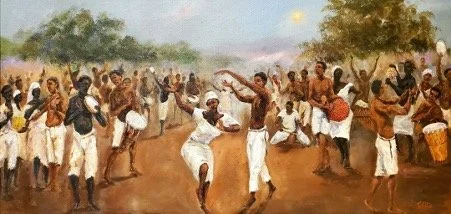
Congo Square, New Orleans – Ted Ellis
Perhaps this is why jazz resonates so strongly with the experience of minorities. We often think about minorities in numerical terms: smaller groups of people that are less represented and less visible. But there is another way to understand it. It is the experience of speaking without knowing whether anyone will listen, of existing without being fully recognized, and most importantly, of adapting to spaces that were not built for you.
Jazz emerged exactly from that condition. And beneath that condition, there was often fear. Not the supernatural one described by Shirley Jackson, but a quieter and more persistent one: the fear of erasure. An entire history, language, and identity could have disappeared; speaking did not necessarily mean being heard.
Unlike fear, which remains trapped in silence, jazz transformed uncertainty into sound. What could not find voice politically found another route through rhythm, turning it into memory. Improvisation became a form of adaptation, and music became a way of saying. It is specifically improvisation that fascinates me the most. Improvisation becomes individuality reclaiming its own voice, a person insisting on presence, a voice refusing silence... it reflects people who must invent themselves while society offers them no stable script.
In this sense, jazz becomes a declaration of presence.
This becomes particularly visible in the story of Ma Rainey.
Known as the Mother of Blues, Rainey performed at a time when being a black woman on stage was already an act of resistance. However, what makes her story compelling is not that she escaped marginalization, but that she transformed it.
Through performance, she created a space where her voice could not be ignored; the stage became a territory of her own making, where imposed identities could be renegotiated. Through music, Rainey gained a visibility that was denied to her elsewhere That is why her story feels larger than music: she confronted a world that sought to define her from the outside. Nevertheless, the difference with Jackson’s novel is that whereas fear often retreats inward, Rainey pushed outward by answering uncertainty with performance and transforming vulnerability into presence.
Yet, her story also reminds us how fragile visibility can be. As musical tastes changed and the Great Depression reshaped the music industry, her career declined. She returned to Georgia and gradually disappeared from public attention. Only later would her influence be fully recognized.
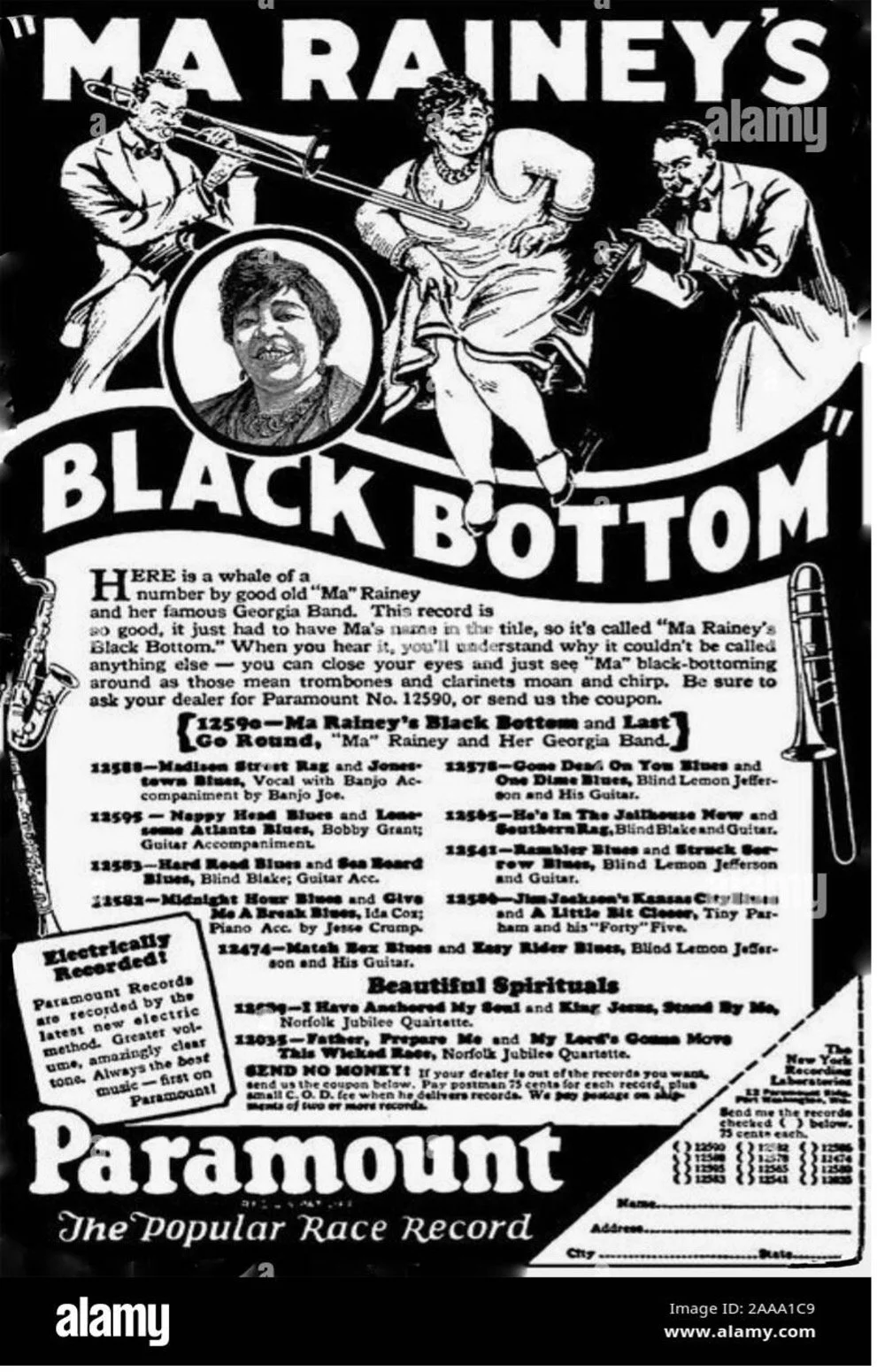
Figure 2 GERTRUDE ma RAINEY (1886-1939)