
MY LIMINAL SPACE IS: THE BED
A LOVE MANIFESTO in our caresses
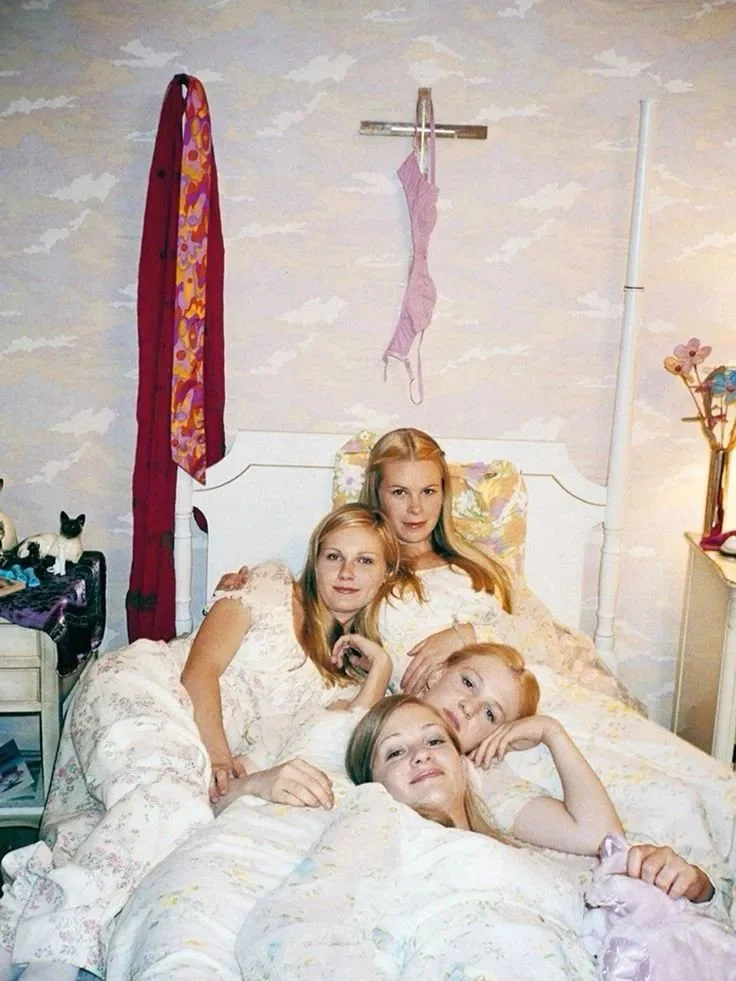
The Virgin Suicides (1999) — Image from the film “The Virgin Suicides”, directed by Sofia Coppola. The Lisbon sisters gathered on a single bed evoke innocence, mystery, and the unsettling closeness that defines Coppola’s atmospheric debut.
Scene 1: (Questo soffitto viola)
Me in bed
It welcomes me with a regal posture when I’m tired after a long day, in exchange for the most sincerely exhausted and clumsy version of myself.
I lie down, I wallow in it; sometimes I cry, sometimes I get angry. I flip through pages on it, I scrutinize my tired limbs and tense muscles. I take on bizarre poses, stretch my legs up in the air only to then turn onto my stomach; I comb my hair with my nails, try to catch glimpses of my own face in the mirror at the side, look at my naked body with either satisfaction or harsh criticism. I allow myself to reproduce natural expressions that I avoid showing outside.
Lying down, I start long phone calls with the people I love and wish were right here next to me, on my bed, so I could touch them or simply enjoy their presence. I hum, I laugh, I touch myself, I surrender, I listen to myself. I try to soothe a moment of sadness—both softened and then fed by the same gentle duvet. I seek shelter in it, and at times I wrestle my way out. I’m moved to tears, a little ashamed of my own sheets, then I forgive myself.
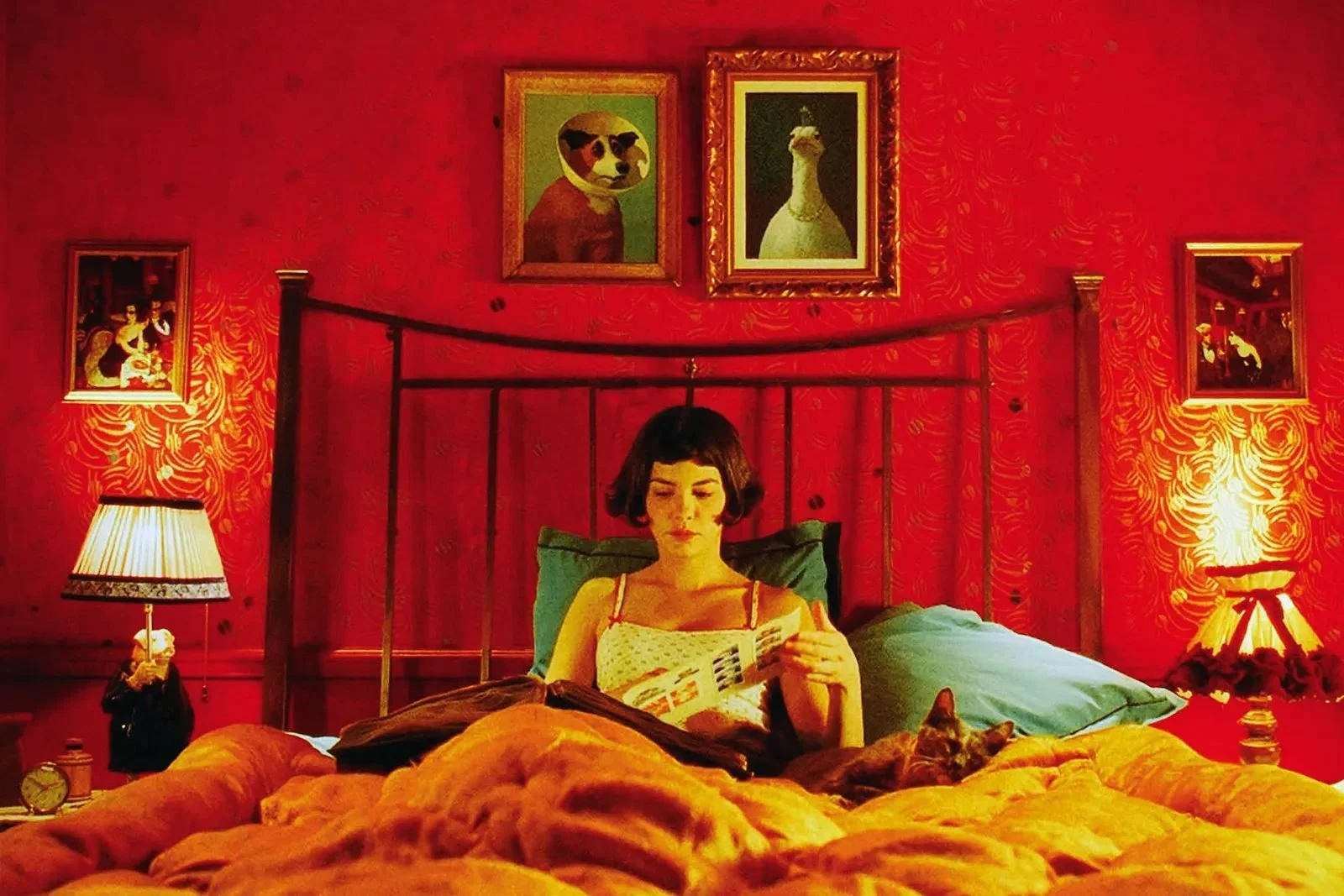
Amélie (2001) — Image from the film “Amélie”, directed by Jean-Pierre Jeunet. A warm, intimate bedroom bathed in deep red tones, capturing the whimsical solitude and inner world that define Jeunet’s poetic visual language.
I watch myself through time whenever a memory grazes me. I watch myself from my bed, in my bed. When I yawn and make myself look ugly, I imagine the ones who, beside me, at least once, have let themselves be ugly without embarrassment, in that sacred place where that kind of silly carelessness is generally granted only to me.
My intimate dimension, the photograph of me as a child staring at me from the wall, my dusty magazines, my film rolls. I’m the only one who looks at these objects, and yet they seem to look right at me. We give each other life and soul; a personal and intimate bond exists between us.
In a bed we are born,
we play, grow, sleep,
we allow ourselves to be ugly and ridiculous,
we make love,
we welcome those we love,
we learn to see,
we die
—if our fate is gentle.
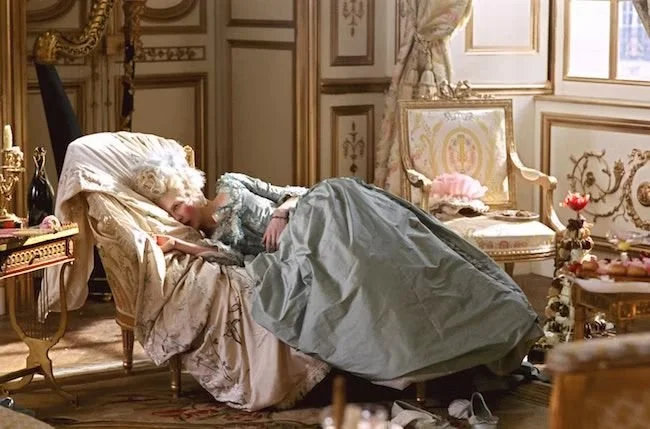
Marie Antoinette (2006) — Image from the film “Marie Antoinette”, directed by Sofia Coppola. The lavish Rococo setting frames a moment of exhaustion and fragility, highlighting Coppola’s signature blend of opulence and emotional subtlety.
I wish I could, though jealous of this intimacy of mine, walk my bed around with pride, put it on a leash, and take it outside.
I’ve somewhat learned why I longed for a caress—perhaps before your large hands, from my own.
Scene 2: Quando sei qui con me ( ) non esiste più.
Io vedo il cielo sopra noi, che restiamo qui.
You in bed through my eyes—pillow side
[Deliberately the longest scene]
Us, staying here.
From my pillow I watch how you look at me, what you leaf through with your eyelashes, which of my flavors you’d like to stroke.
It is so sootingly strange to feel the other’s pulse and ours moving on, uncoordinated, in different tempos. It is so annoyingly tender to accept that we can spend an uncomfortably long day in the company of another human being, only to find ourselves lying down with that person’s scent wedged between our nostrils. The sweet surrender: we switch off in that childlike need to fall asleep peacefully beside one another. Morbidly surrendered.
In bed, everything we’re not remotely conscious of happens, and sometimes the exact opposite of the certainties we thought we had appears. A tension fades, just as what seems balanced from the outside can become constricting. We are sweetly helpless before any attempt at analysis.
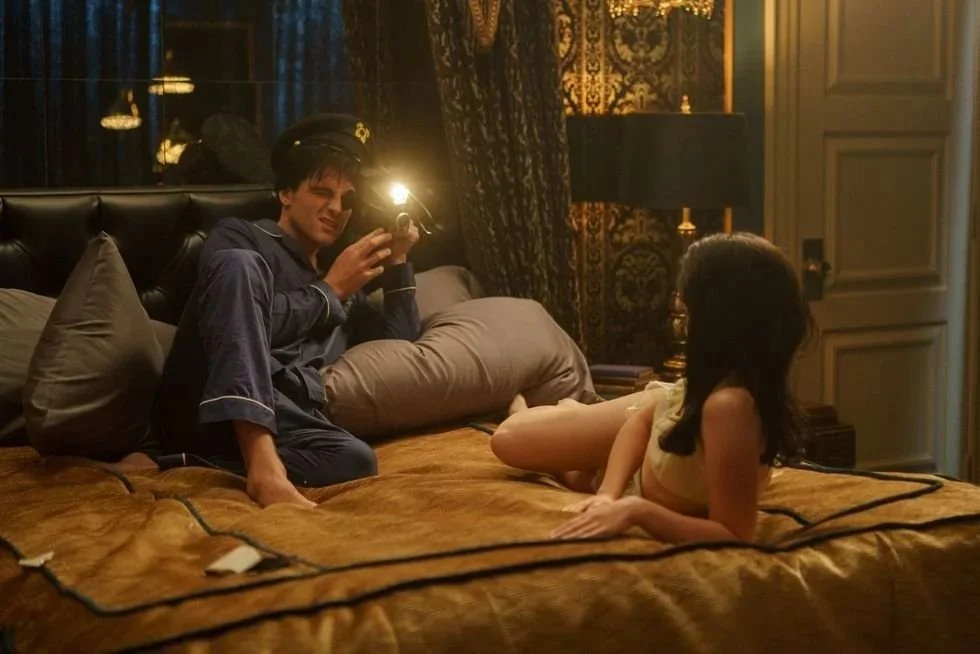
Priscilla (2023) — Image from the film “Priscilla”, directed by Sofia Coppola. Elvis, Priscilla Presley and the close encounter: a private, stylized bedroom moment that reflects Coppola’s delicate portrayal of intimacy, control, and emotional distance.
Questa stanza non ha più pareti ma alberi infiniti [endless trees]
because with each of your caresses, the bed expands into a space that—in truth —you are taking a little away from me, but your presence becomes an added value in my small and now not-so-shy room.
Alberi infiniti [Endless trees]. How do we ask for caresses? Maybe we learn it in our childhood homes. I took the intense caresses of my mother and the rhythm of touching from my father. From them I learned how to caress and how to ask for caresses, and I wouldn’t have wanted any other seed from which to learn how to love . My home was never a place of perfect balance, but even when wounded or tense, we always gave each other caresses, and always will—especially the uncomfortable ones. And I too, even when tense or wounded, love giving mine—measured, yet intense.
It’s a fundamental pillar for me, and I believe for part of my bloodline, to consider this seemingly light and spontaneous gesture as something with a certain specific weight. I may struggle to ask for a caress, but if I place my hand on your face it’s because, in my heart, I am accepting the emotional responsibility that has already formed, spontaneously—not when you entered my space, but when you became part of it. When you timidly asked me for a caress.
Not every home teaches that when you caress someone, your hand shouldn’t weigh. I don’t think I’ve ever felt heavy hands on my face, though maybe at times I’ve received caresses a little too light. And yet, your hand is now part of my pillow, and I fall asleep with your fingers in my hair.
My relationship with the objects in the room has now grown more complex. You look at my childhood photo too, and you don’t know whether that little figure with braids welcomes you with open arms or somewhat judges you a little. And I don’t know whether those braids unsettle you or make you feel important for giving you that micro-responsibility of being part of my biography.
You cannot know it, but you’re creating an intimate relationship with objects deeply present in my life—objects that once belonged to someone who passed on the way I now look at and love you.
My purple ceiling [soffitto viola] has been demolished, and I wonder how long I could stay here with you in a room without time.
From the comfort of your yawn, from the way you settle in tangled around me and yawn in that silly way right next to me, all I can do is admire how easily you love. Without pretending and, I hope, without deceit.
I hesitate a little, but I enjoy your presence in person and I wonder, if I were in your room, how I would find myself yawning, and how my presence would be welcomed by you. I know for certain you would ask me for a caress.
I wish you could walk your bed around with pride, put it on a leash and take it outside, with me inside
hidden from indiscreet eyes
and my laughter echoing from beneath the covers.
Scene 3: Abbandonati come se non ci fosse più niente al mondo
You & me softly giving in
I wish you could welcome the same caresses you long for.
My liminal space isn’t the bed itself, but that invisible lens between the sheets and the mattress that allows us to observe one another.
When we emerge from under the covers, we become frightened by the intensity we’ve lived, and we leave. We are capable of holding the love that arises when we truly see the other, but not before knowing that we crave that sight. I saw your gaze support my truth without fear, but how long can a moment stretch across time and remain held?
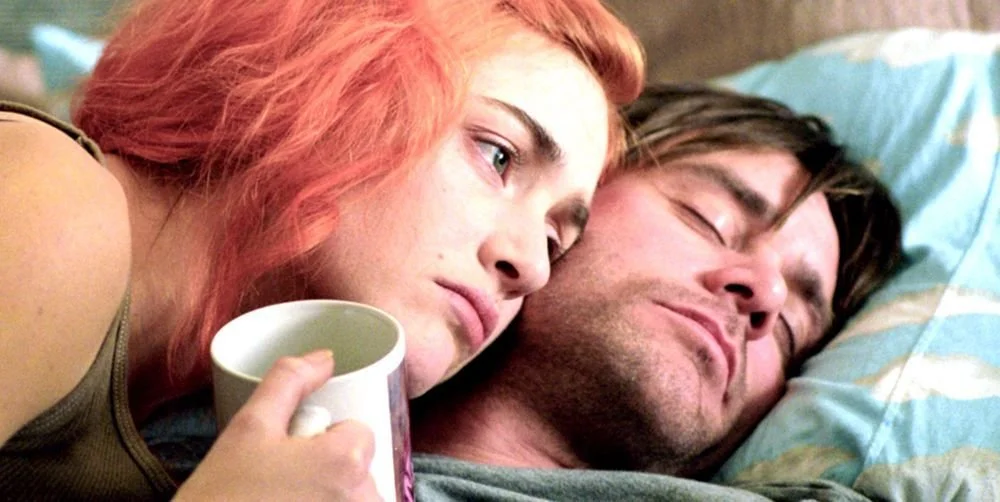
Eternal Sunshine of the Spotless Mind (2004) — Image from the film “Eternal Sunshine of the Spotless Mind”, directed by Michel Gondry. A quiet, intimate moment that encapsulates the film’s tender meditation on love, loss, and the persistence of feeling.
In bed, it is easy to let ourselves be revealed, and not out of sheer desire or pleasure. It is even simpler and more intimate once seduction collapses: we cannot help but see each other exactly as we are, and we cannot avoid surrendering to each other’s rawness—our expressions, our caresses, our ugliness, our yawns.
We are forced to shed our rigidity, and we realize how pointless it is. Yet we rebel against the truth of this more authentic moment, because we like the idea of the ethereal dream. The dream lets us dodge social responsibility while still remaining emotionally involved, because we’re still participants.
We want only what is beautiful and soothing, but before letting ourselves be absorbed by it, we insist on waking up. Exactly like my small body in Scene 1 slipping out from under the covers, afraid of feeling too safe.
No one should find themselves dragging around an empty bed without knowing why it was emptied: it’s like letting a caress die. We crave emotional intimacy that we’re not capable of sustaining. Feeling alive shifts from being the aim of our existence to something we can’t fully carry.
The monsters under adult beds: rather than look beneath the mattress, we’re willing to lose the ability to love. How ridiculous the rigid human being is.
The only ones truly free from this unhappy spell are those who start from the ethereal dream as the very blueprint of existence, an ideal draft upon which to adapt the ordinary, not just a fleeting attempt at aestheticizing life.
I hope to have the courage to live forever for that intensity from which others run, and above all, to never forget those who asked me for and gave me caresses.
Those who did aren’t under my bed, but they are surely stuck in it somewhere, and that makes me smile a little.
I smile because you got stuck in my mattress while looking at me with eyes so sweet that I can see it, you still struggle to fully hold them. I tease you a bit, you who love caresses more than I do, and you are in that small liminal space that belongs entirely to me. And me, in that small liminal space that is entirely yours, lying comfortably.
Love does not die; it is an emotional inheritance we pass on, and that is passed down to us.
Even if you hurt me, I inherited one of your expressions and I use it almost without noticing. Then I notice, and I smile.
Even if I hurt you, your laugh has taken on a bit of my rhythm. I wonder whether that pleases you or embarrasses you.
The truth is that when we love, we change.
Even when we don’t have the courage to embrace what’s real and instead escape into the ethereal dream, we flee already altered by someone’s love. Love does not die. The way you caressed me is how I now caress. Your love for me lives on forever in the movement of my tired hands.

Eternal Sunshine of the Spotless Mind (2004) — Image from the film “Eternal Sunshine of the Spotless Mind”, directed by Michel Gondry. A surreal tableau — a bed stranded on a winter beach — reflecting Gondry’s dreamlike approach to memory and emotion.