
MY LIMINAL SPACE IS: ANEMOIA MELODIES
Everywhere at the End of Time, an Empty Bliss
Have you ever felt that sense of not belonging? Have you ever wondered why it seems like everything has a meaning, yet you are not able to find it? Well, if you have don’t worry, you are not going crazy: you are just probably listening to The Caretaker’s music.
Leyland Kirby, aka The Caretaker, transforms that feeling of being “in between” with his melodies and distorted sounds, making us forget our living state and leaving us toward a resemblance of reality — a dreamy world that becomes both material and intelligible, yet also uncanny and incomprehensible.
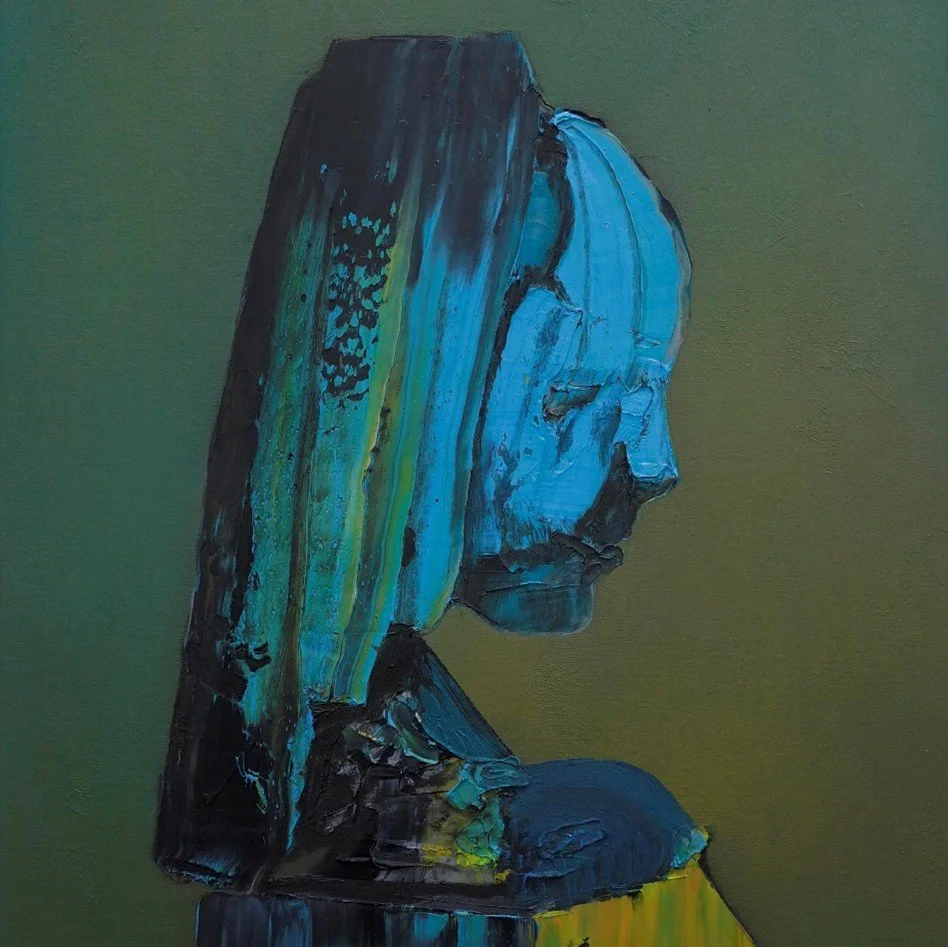
Ivan Seal, Giltsholder (2017), oil on canvas — cover artwork for The Caretaker’s, Everywhere at the End of Time, Stage 4 (2018)
What if we tried to give some rules to that feeling? What if we try to give some rules to that feeling by going beyond its mere acceptance? Being confused is at the basis of existence: we start asking questions as soon as we acquire the ability to speak. The point is, most of the time, we do not receive in return the clear answer we were hoping for. What would have brought us sought internal peace is still missing.
Back in 1909 , the French anthropologist Arnold van Gennep tried to clarify that inadequacy by dividing it in a three-fold structure of liminal rites. According to him, we first enter the “rite of separation”: this stage involves a metaphorical death, as we are forced to leave something behind, to forget about our usual routines. Then we approach the main phase, the “transition rite”; this middle stage implies an actual passing through the ambiguous threshold that marks the boundary between past and present. Finally, we are reincorporated into reality during the “incorporation rite”; we are shaped as new beings, not deprived of our intellectual sensitivity, but on the contrary we are more thrilled with it, we have left the old meanings, but the new ones are yet to be formed.
“Life itself means to separate and to be reunited, to change form and condition, to die and to be reborn. It is to act and to cease, to wait and to rest, and then to begin acting again, but in a different way.”
- Arnold van Gennep
So, what does The Caretaker do with all that confusing and apparently useless digression?
Well, actually a lot. As already mentioned, the main aspect of this artist’s music is the relationship between sounds and unexplainable emotions. With his projects, Kirby tries to recall the symptoms of dementia, the disease that best incarnates the concept of liminality. By listening to his catalogue of albums “everywhere at the end of time”, we feel like moving through an old hotel of the mind, where every corridor looks the same, and our memory is deceived by our imagination. Rooms echo, slowly fading away, eventually coming back and quickly distorting, or even… vanishing into silence.
“Once people become unaware there is a problem. Then there is a drift in thought patterns, also reality crumbles. Dreams/Nightmares become a reality, confusion sets in.”
- Leyland Kirby
Inspired by both the 1980 movie “The Shining”, with its unmistakable scenarios and the 1920s ballroom music, the Caretaker decided to build a bridge between anthropology and aesthetics, transforming the notion of the “being in between” into an audible experience. The rites described by Van Gennep are no longer merely related to physical places or empirical experience: with his loopy sounds, Kirby makes us feel these places existing between presence and absence, past and present.
His melancholic melodies basically invite us to liminality, Anemoia.
The tunes seem familiar, yet we can’t grasp them, we feel forlorn even if we know that we have never lived that moment, as though we were walking through the memory of a room rather than the room itself.
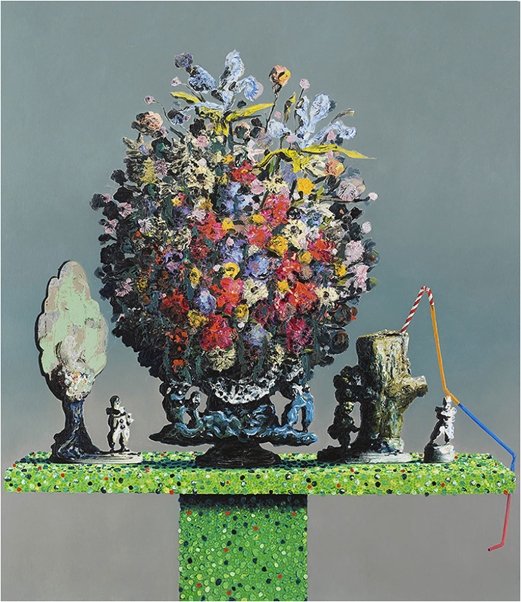
Ivan Seal, Corapy Invalidates the Mess with Every Residence (2016), oil on canvas, 150 × 130 United Kingdom.
“Everywhere at the end of time” represents clearly the bridge that we have cited previously: the six albums can be divided into the three main phases analyzed by Van Gennep. The clear melodies and fading transitions of the first two stages are the starting point, embedding the separation of the mind that rejects the world of coherent memory. They prepare the individual for the crucial phase: the severance from identity, and what it’s solid to its core is about to take place. Nothing can interrupt the flow of the following three groups of compositions that make us forget about the time passing by, and just when we start to feel more comfortable with that distortion and confusion, here it comes, with its unmatchable aura and scary outspokenness:
silence.
Void: that’s what is left.
Six hours have passed since we started listening to it. We have been hoping to find some sort of truth in the final songs of the project, but what should have been the perfect ending just revealed itself as the worst beginning. We start to understand that kenopsia — that eerie feeling of knowing that everything that felt meaningful — is now reduced to mere emptiness.
However, is it so?
An empty bliss,
that’s what is really left.
What does it mean? Why are we surprisingly feeling different? Those melodies seemed so unfamiliar and frightening, but still, we feel that something has changed. Van Gennep was not that wrong.
We feel reincorporated.
We are embraced by the oblivion.
We are new beings, aware of our unawareness — as Socrates would say.
Nevertheless, there’s always creation in disruption. There’s a movement in us, even if everything seems static, we are creating something, and we find that something in that liminal space between reality and memory: music.
Hence, music becomes the ghost of memory, the trigger that allows us to create art, to transform absence into presence. Through that aesthetic experience, the non-belonging becomes belonging.
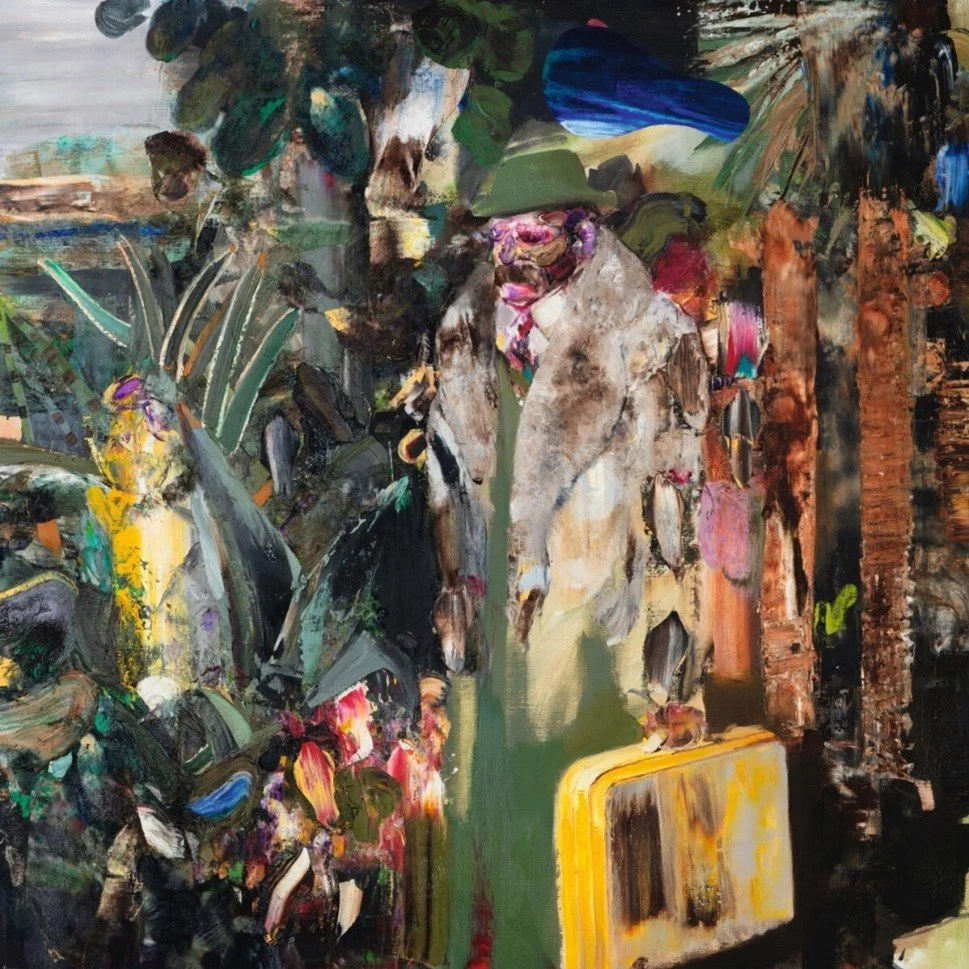
Adrian Ghenie, Untitled (c. 2010s). Oil on canvas. Figure with a suitcase, poised between departure and return, dissolved into a blend of colour and memory.