A MANIFESTO ON MINOR VOICES
Voices do not enter the world unframed. They arrive already situated, carried by structures that shape their weight, their legitimacy, and the distance they are allowed to travel. There is a reason, after all, that some people wish to colonize the moon, while others dance before it as an ancient friend. The difference is not in the object, but in the position from which it is seen.
Minority, then, is not simply a matter of identity — not only who someone is — but where someone is placed within these structures of recognition. It is a position produced through relations of power, the patterned arrangements that distribute privilege, constraint, and exposure unevenly across social life.
We traced liminal spaces. Thresholds. Bedrooms. Airports. Subway platforms. Spaces that held us while we were becoming. They were intimate. They were ours.
But becoming does not unfold in neutrality. It takes place within architectures that precede us. Lines are drawn before we step into the room.
To speak of minor voices is not simply to make them visible. It is to interrogate how position is produced, how visibility operates, how frames are constructed, and how responsibility emerges once we recognize that none of these processes are innocent.
Visibility does not automatically redistribute power: to be illuminated is not necessarily to be centered. Art, media and institutions do not merely reflect reality; they stage it. They determine what appears, how it appears, and under whose authority it circulates.
And we are not outside this staging.
We write and publish from positions that grant us legitimacy. Our voices move differently because they are already situated differently. To ignore this is to sustain the illusion of neutrality we seek to dismantle.
In all beginnings there are words. Words are bridges to the other. Words are a revelation to oneself. Words hang in the air, move from tongues to ears, penetrate the soil as clandestine fertiliser, their sounds, rhythms, and melodies perfuming the air.
This manifesto begins there: with words that do not simply describe the world, but move within it, unfolding through four interwoven tensions — position, visibility, art, and responsibility — not as separate chapters, but as layers of the same structure.
If the line is constructed,
if the frame is held,
if the spotlight does not shift the stage
then the question is not only who stands at the margin.
It is where we stand,
and what that position demands of us.
I. Drawn Into Position
We often speak of minorities as identities, as if difference itself were the problem. As if culture, language, gender, or skin were the cause of exclusion.
But identity does not draw borders.
Position does.
To succeed, must one stand above another?
The fear of failure drives aggression; it convinces us that power over another will prevent oneself from becoming the oppressed. But if the line is not natural, why do we keep redrawing it vertically? Why must we assert a higher position than an equal to live in our own customs and practice our own culture? Why does coexistence so often seem to require hierarchy?
Colonialism offers not only a historical example, but a structural one.
From its inception, it imposed hierarchy, not simply separating groups, but denying shared ground between them. It was not only an occupation of land, but an organization of value.
A boundary was built that was not simply horizontal, but vertical. A hierarchy that determined whose knowledge counted as universal and whose was reduced to folklore. Whose culture was civilization and whose was deviation.
It is not identity that drove a wedge between conqueror and native, but the entitled position of the conqueror that allowed them to dominate equal beings. The power to define and to narrate reality. This was the true border.
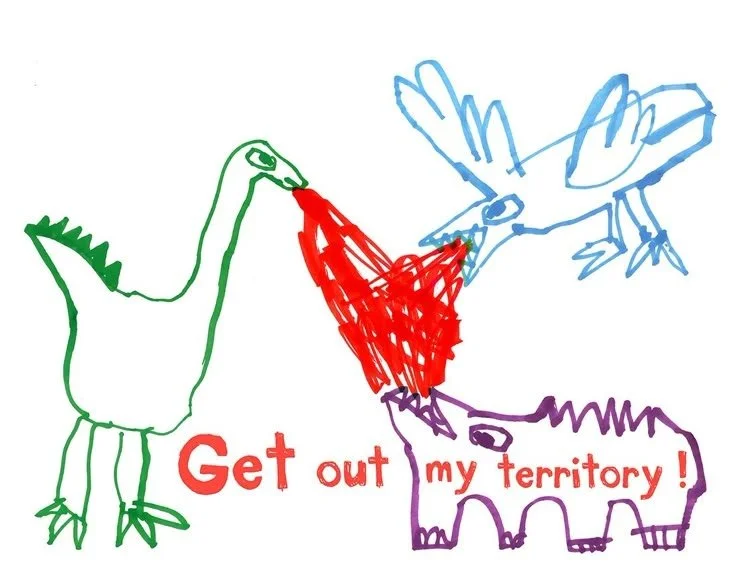
Over time, that wedge hardened into violence, into systems, into institutions. The acknowledgment of entire groups of people began to wither, not because they lacked identity, but because they were denied authority.
The subaltern are said to be oppressed, residing outside the borders of political, social, and economic power. But perhaps the subaltern are not defined by who they are, but by where they are placed. At the edge of recognition itself.
Their speech may exist, but it does not circulate equally. It must pass through filters. It must be translated into acceptable language. It must be softened, reformulated within frameworks that were never built for it.
How can someone excluded from power fully belong to society? Do they have space to speak? And if they are represented, are they truly heard or is their speech filtered through the very structures that exclude them? When we consider the subaltern, do we listen? Or do we interpret them through categories we already understand?
To characterize the subaltern risks repeating the violence of classification, marginalizing diversity and creating a hierarchy of minorities. We remain stuck hoping that they have enough power to make themselves be seen.
Forcing visibility can replicate domination, imposing our own frameworks once more. But indifference preserves exclusion. Where, then, is the balance? How do we engage without reinscribing hierarchy?
Today these boundaries are rarely invisible. They are institutional. Embedded in education, language, representation. Post-colonialism can only be categorized as 'post’ because the conquerors no longer physically occupy the land, yet the logic of hierarchy persists. We live in a world where colonial structures survive less as invasion and more as organization, as quiet systems that determine who is central and who remains peripheral.
Position is not accidental. It is produced.
To speak of minorities, then, is not to romanticize marginality, nor to freeze identity into a fixed condition. It is to explore how positions are produced and how they might be unsettled.
Before there is visibility, there is placement. Before someone is seen, they are located within a structure that decides whether their voice will carry weight or dissolve at the margins.
The line does not begin with appearance.
It begins with position.
II. The Paradox of Visibility
If the line holds in the architecture of placement, what happens when those at its edge step into the light? Does visibility alter position? Or does it simply illuminate the boundary more clearly?
There is a peculiar paradox at the heart of modern society: some people are everywhere, and yet nowhere at all. They appear in our timelines, in political speeches, in corporate campaigns, in university syllabi. They are debated at dinner tables and dissected in comment sections. Their names become hashtags. Their struggles become headlines.
And yet something remains unseen.
Minorities have always existed. Difference is natural; variation is the rule, not the exception. It is the condition of life itself. In nature, diversity sustains survival. In human societies, however, difference has often been converted into value.
For centuries, many minorities were not simply marginalized but erased. Their lives unfolded in the shadows of official history. Their struggles were whispered, if acknowledged at all. Civil rights movements, feminist movements, LGBTQ+ activism, were, at their core, battles for recognition — for entry into law, institutions, and visibility itself.
To a large extent, those battles changed the landscape.
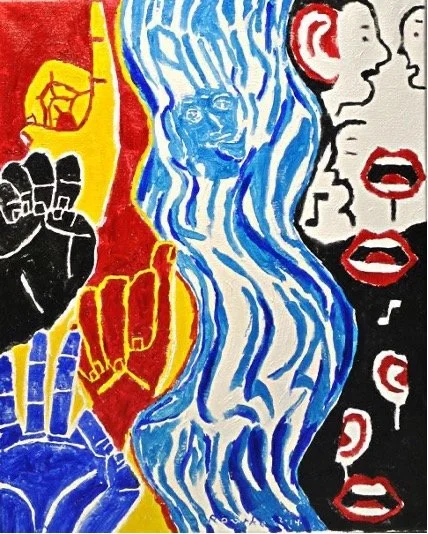
Today, minorities are visible. Represented in media. They are protected (at least formally) by legislation in many countries. They are spoken about, written about, studied.
But visibility does not automatically transform the structure that produced marginality.
On one hand, increased representation has demystified difference. The unfamiliar becomes ordinary when it is encountered often enough. What was once feared can become simply another facet of social life. Something does shift in that familiarity. A generation growing up seeing diverse identities normalized on screen and in public life may inherit a world less shrouded in silence.
On the other hand, visibility introduces a new economy.
Once something becomes visible, it can be consumed.
Corporations have learned that aligning with minority rights can generate profit. Rainbow logos bloom in June. Diversity becomes a marketing strategy. Inclusion appears as a bullet point in annual reports. Advocacy becomes aesthetic. Support becomes branding.
Recognition, when conditioned by marketability, is fragile.
When justice becomes trend, it fluctuates with demand. Lived experiences risk being compressed into symbols — portable, profitable, palatable. When appearing “woke” ceases to be advantageous, solidarity can quietly dissolve.
Thus, minorities become hyper-visible and strangely abstract at once. Everywhere as concept, rarely encountered as complexity.
Perhaps what we witness now is not oblivion, but willful ignorance. Minorities are discussed incessantly, but often without listening. They become topics rather than participants. Their existence fuels political campaigns, their rights are bargaining chips in elections. They are invoked as statistics on a presentation, instead of real people that are woven in the fabric of society. This is the strange condition of being visible but not truly seen.
To be seen is to be acknowledged as a subject, not an object.
It is to have one’s voice carry weight. Visibility without agency can become another form of subordination. The dominant group still defines the terms of the conversation. It still decides which identities are acceptable, which demands are “reasonable,” which forms of protest are “too much.”
Then, is making minorities visible a form of liberation, or a subtler form of control?
Visibility opens doors. It enables connection, solidarity, mobilization. Social media amplifies voices that once struggled to circulate. But visibility also exposes. It invites scrutiny, backlash, commodification. It fixes identities under a spotlight that does not necessarily translate into power.
A society obsessed with appearances may celebrate diversity as long as it remains legible, aesthetic, profitable. But what happens when visibility does not soothe? When it disrupts?
If the structure remains intact, the spotlight does not dismantle the stage. It merely clarifies who stands at the center and who performs at its edge.
Until visibility alters the conditions of placement, minorities remain suspended in a paradoxical space: omnipresent and displayed, but still negotiating the terms of their own existence.
And perhaps the most subtle form of control is this:
to be seen everywhere,
and yet never be the one who decides how the scene is arranged.
III. Decorating the Border
If visibility can illuminate without transforming, then art becomes one of the spaces where this tension is staged most clearly. Museums, galleries, screens -- these are not neutral containers but choreographed spaces. They are sites where visibility is curated. If minor voices can be seen and still remain peripheral, we must ask: who designs the frame in which they appear?
Minorities in art are not simply underrepresented identities. They are positions within a structure of power. They are those whose bodies, languages, and aesthetics have been framed, translated, consumed, or silenced by dominant narratives. In cultural production, this often means being made visible without being heard, included without being centered, aestheticized without being understood.
Art history is full of such paradoxes.
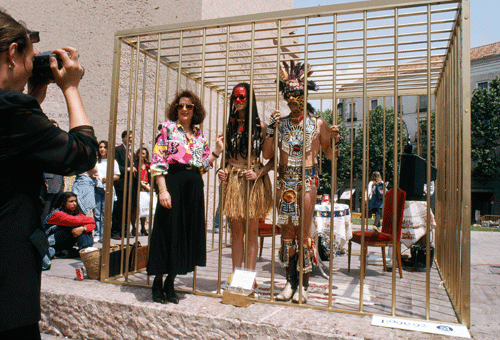
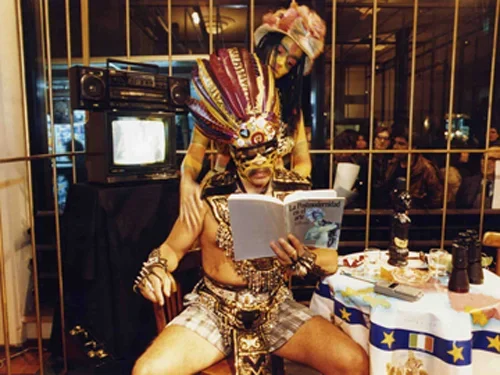
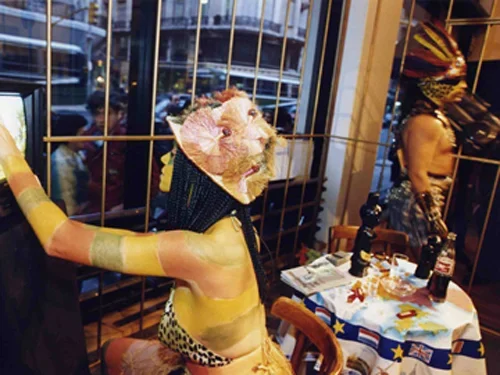
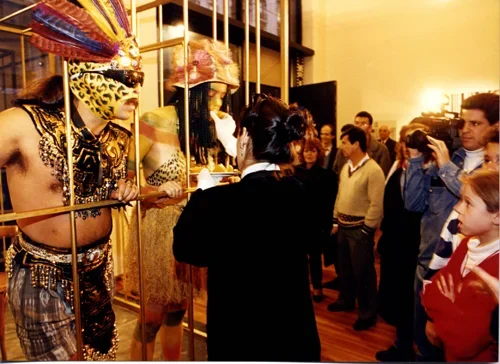
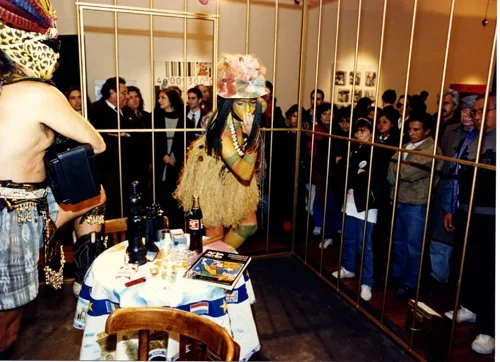
In 1992, Coco Fusco and Guillermo Gómez-Peña performed Two Undiscovered Amerindians Visit the West. They placed themselves in a cage in museums across Europe and the United States, presenting themselves as fictional “undiscovered natives” from an island in the Gulf of Mexico. Visitors paid to see them. Some laughed. Some believed the fiction. Some felt uncomfortable but still looked. The performance did not invent colonial violence; it revealed its continuity. It showed how easily the Western gaze consumes alterity, how quickly the museum can turn difference into spectacle.